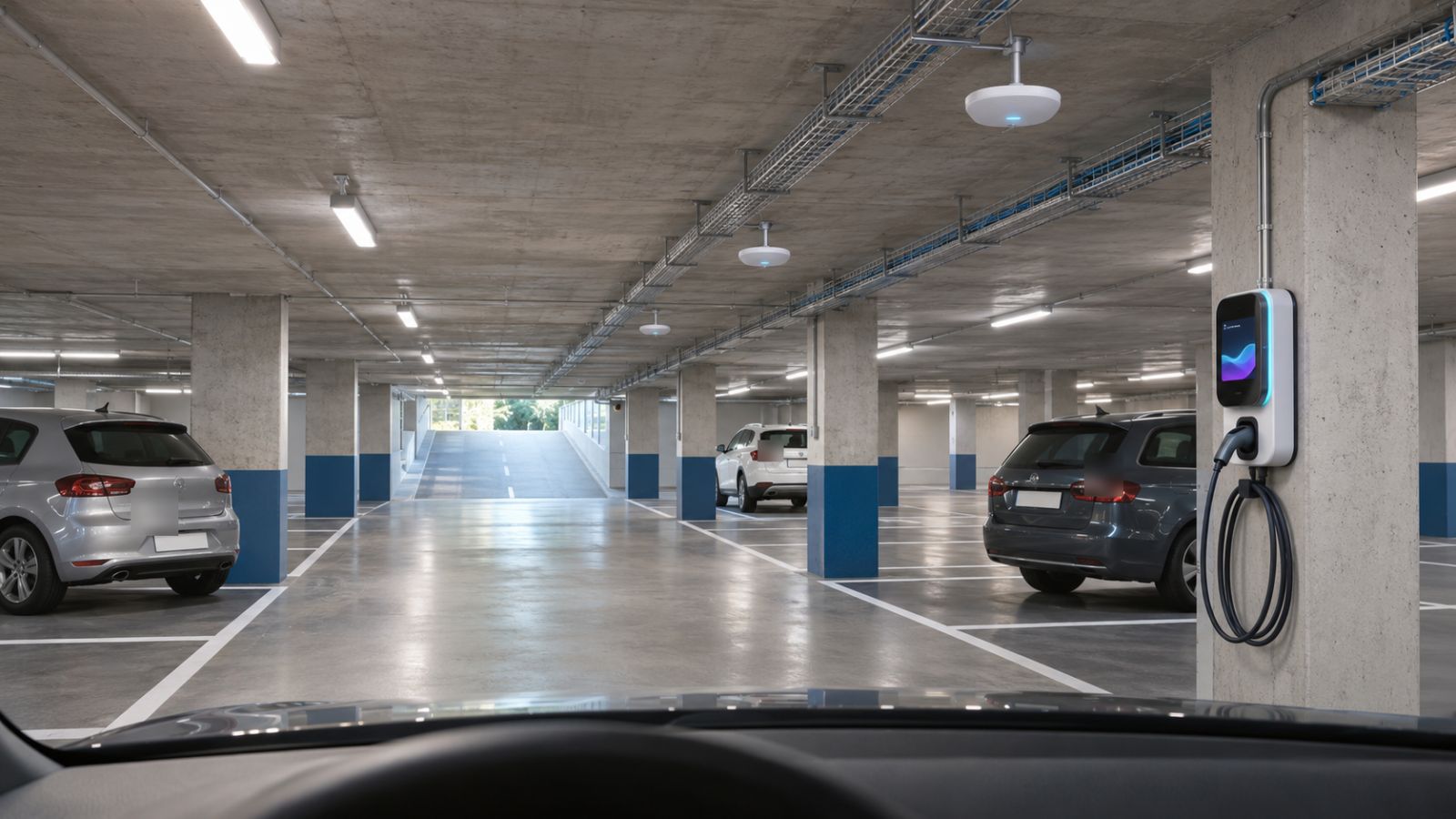
Mobile and radio coverage in underground car parks
Concrete and depth stop the signal, yet people below ground need it: for parking and charging apps, payment terminals and emergency calls.
Why the signal fails here
- Reinforced concrete and soil block almost everything from outside. Each level down is usually worse.
- Ramps let some signal in, which is why coverage often stops a short way past the entrance.
- Charging stations, payment terminals and barriers may rely on the mobile network as well.
- Drivers use every operator, so a system for one operator solves the problem for only part of them.
Which system fits
Repeater and ceiling antennas
An outdoor antenna that picks up the operators’ signal (the donor antenna), on the roof or at ground level, and a repeater, a box that amplifies that signal, feeding antennas along the driving lanes. Fits smaller car parks with a usable signal outside, once the operators agree.
Part of the building’s DAS
Under an office or hospital, the car park is best treated as one more zone of the building’s distributed antenna system (DAS): one network of antennas fed from a central point. The BIPT guidelines name underground parking among the areas a multi-operator DAS should cover.
Fibre-fed remote units
For large or separate car parks, where the distance from the donor antenna or the technical room is too long for coaxial cable, the usual antenna cable. Optical fibre then carries the signal to small units close to the antennas.
Who has to agree
These rules apply in Belgium. In other countries the principle is usually the same, but ask the local operator.
Mobile operators
A repeater or DAS may only carry a mobile network with the permission of that network’s operator, and a system that carries several networks needs the permission of each operator. Only operators may activate active equipment in their bands, and BIPT only allows repeaters that operators install themselves or accept responsibility for. The Belgian regulator BIPT explains this on its website. The agreement therefore comes before anything is bought or switched on.
ASTRID, the radio network of the emergency services
For new large buildings and infrastructure, a Safety Commission under the FPS Interior decides whether indoor ASTRID coverage is required. The building owner then signs an agreement with ASTRID, the design goes to ASTRID for review, and ASTRID inspects the installation before it connects. The owner then sends ASTRID a maintenance report every year. ASTRID’s review only confirms that its network is not disturbed, not that coverage is sufficient. ASTRID describes the procedure on its website (in Dutch and French).
ASTRID only accepts repeaters and base stations it has validated. The models in our catalogue are not on the list ASTRID has published (January 2024 version), so for a project on its network we check the current list with you before anything is specified.
One of the criteria ASTRID lists is an underground space larger than 25 m² that is publicly accessible or stores dangerous substances. Every new large project must be submitted to the Safety Commission, which decides per file, so plan for this early and allow for it in the budget.
How a project runs
- 01
Measure
Signal per operator and band in each zone, and the outdoor signal where a donor antenna could go.
- 02
Choose the route
A solution from the operator, a repeater or a DAS: this depends on the size of the site, the signal available outside and the number of operators.
- 03
Design
Antenna positions, cable routes, a link budget (the calculation of signal levels from source to antenna) and the equipment list.
- 04
Request the agreements
Technical information for each operator and, where needed, for ASTRID. Nothing is ordered or switched on until each of them has agreed.
- 05
Supply and install
Equipment with a test record per unit. Your installer does the work, or a contractor agreed with you for the project.
- 06
Commission and maintain
Measuring the signal on foot through the site (walk test) against the design, and handover documents. Regular maintenance follows under its own contract, with your installer or a maintenance firm.
If you own or manage the site
- Send us the plans and tell us where the signal fails. You do not need to know the technology.
- We measure, propose a route and tell you which agreements it needs, scoped and quoted per project.
- We prepare the technical information each operator asks for: bands, gain, output power and location.
- Installation is done by your own installer, or by a contractor agreed with you for the project.
- Ask your main operator as well: operators also offer indoor solutions of their own.
If you are the integrator
- Product selection for the site, from the catalogue or to a build specification.
- Support on link budgets, DAS layouts, measurements and commissioning: see engineering support.
- A test record with every unit, and one contracting party in Brussels.
- Your own product line if you need one: see OEM / ODM.
What to send us
- Plans of each level, with ceiling height
- Who uses the car park: public, tenants or staff
- Where a donor antenna could go, and the cable route to it
- Power available, and a place for the equipment
- Whether charging stations or terminals need the network
Common questions
Can we just buy a booster online?
Not without the permission of each operator whose signal it carries. BIPT forbids the use of repeaters without that permission, and a poorly adjusted booster can disturb the network for others.
Does a car park need ASTRID coverage?
It depends on the project. For new large works, the Safety Commission decides per file; a publicly accessible underground space larger than 25 m² is one of its listed criteria.
Which operators can be covered?
As many as agree. A system can be designed to carry them all, and an operator can join later if the design has allowed for it.
Who owns and maintains the system?
Usually the owner of the car park or building, or a specialised firm. Decide this at the start: the operators will want one point of contact for faults.
Other sites
Office buildings
Insulated façades and deep floor plans block the signal. Tenants use different operators.
Hospitals and care campuses
Staff, patients and visitors on every network, in a building that cannot stop working.
Multi-operator DAS
How the Belgian process works: notification, operators’ answers, design, activation and maintenance.
Tell us about the site
A few answers are enough for a first product selection.
Planning a product line under your own brand? Use the OEM / ODM form.
- A product selection for the site
- A first link budget where the site needs one
- The list of what we still need from you, such as floor plans or donor measurements
You can attach floor plans here, or send them by email later.