Multi-operator DAS in Belgium: how the process works
A multi-operator DAS (M-O DAS) is one passive antenna network in a building that every mobile operator can connect to. BIPT and the operators have published guidelines for it, last updated in 2025. This page sums them up.
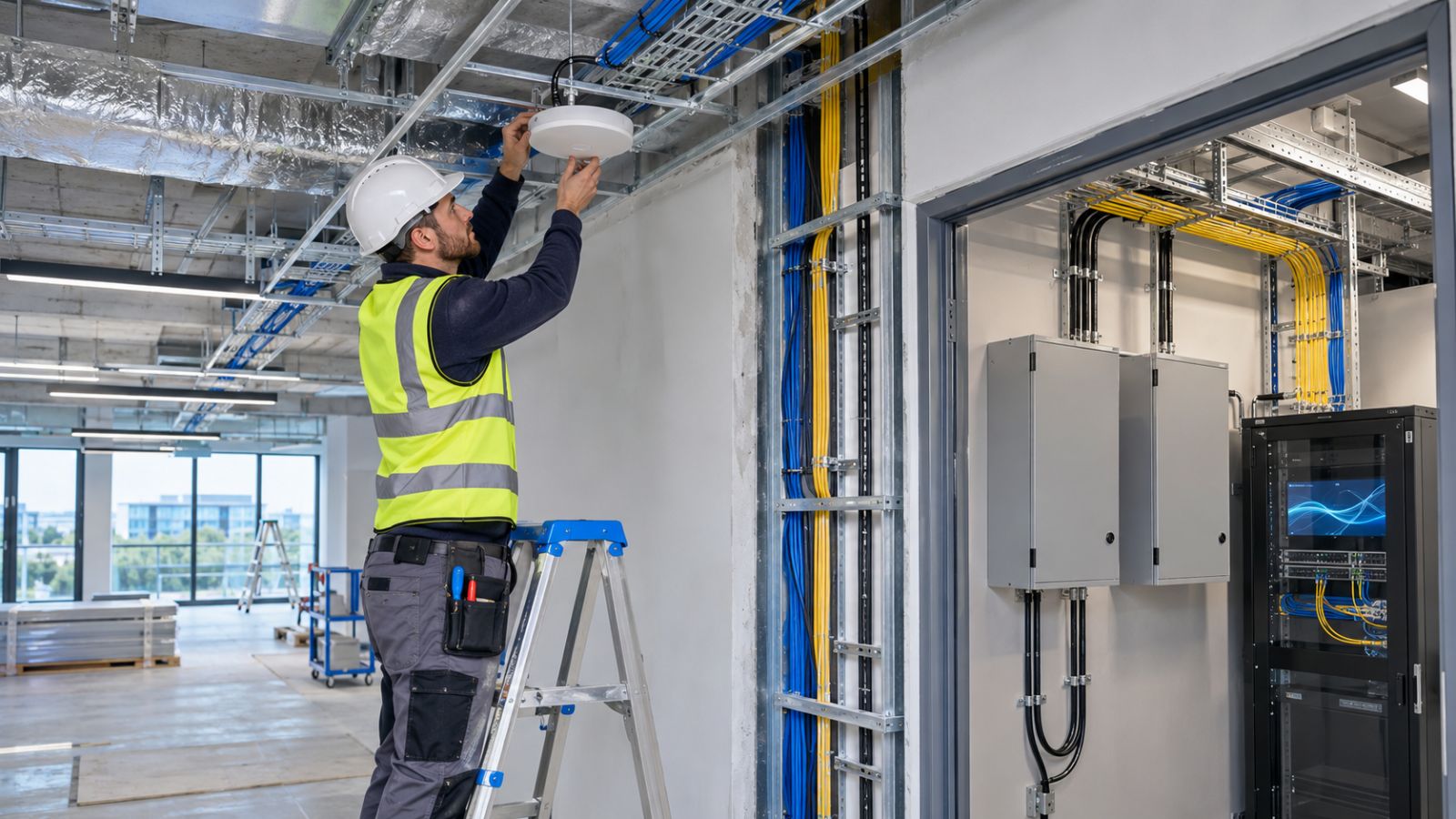
What it is, and what it is not
- A passive network of antennas, cables, splitters and combiners. It usually belongs to the building owner, but an operator or a third party can also own it.
- The active radio equipment, such as base stations or repeaters, is installed and operated by each operator in a technical room.
- It covers the licensed mobile bands (700, 800, 900, 1400, 1800, 2100, 2600 and 3400–3800 MHz) and can also carry ASTRID, if that is in the design. The guidelines advise against combining the 3400–3800 MHz band with ASTRID on one system, because the bands are so far apart.
- Active systems such as small cells or active DAS fall outside these guidelines.
- The guidelines are recommendations. But operators only connect if the processes and requirements have been respected.
The three phases
1. Pre-design
While the building exists only on paper or before a major renovation. The owner sends a notification form and a conceptual design through the BIPT M-O DAS portal. Operators say within 15 working days whether they are interested, with a non-binding view and rough costs. The owner then decides.
2. Execution
Once the walls and windows are in, or straight away in an existing building. The DAS contractor sends the request, holds a site visit and submits the RF design, which operators review within 20 working days. Then come installation, as-built documents with PIM and VSWR reports, an acceptance visit and activation per operator.
3. Operation
The owner stays responsible for the DAS for its whole lifetime, usually through a maintenance firm, and gives operators one point of contact. Operators maintain their own active equipment.
Figures from the guidelines
Baseline values in the General Guidelines of January 2025, for orientation. The detailed technical annex and each operator’s final answer take precedence.
| Indoor signal, 2G | BCCH –85 dBm (95 % of the area) |
|---|---|
| Indoor signal, LTE | RSRP –95 dBm (95 % of the area) |
| Indoor signal, 5G | RSRP –105 dBm (95 % of the area), band n78 |
| Compared with the outdoor signal | At least 10 dB stronger in urban areas, 6 dB in rural or suburban areas |
| Leakage outside the building | 15 dB below the dominant cell |
| Floor space, medium project (30–40 antennas) | At least 2 m² per operator |
| Floor load, technical room | 250 kg/m² |
| Operators’ answer to the notification | 15 working days |
| Operators’ review of the RF design | 20 working days |
Who has to agree
These rules apply in Belgium. In other countries the principle is usually the same, but ask the local operator.
Mobile operators
A repeater or DAS may only carry a mobile network with the permission of that network’s operator, and a system that carries several networks needs the permission of each operator. Only operators may activate active equipment in their bands, and BIPT only allows repeaters that operators install themselves or accept responsibility for. The Belgian regulator BIPT explains this on its website. The agreement therefore comes before anything is bought or switched on.
ASTRID, the radio network of the emergency services
For new large buildings and infrastructure, a Safety Commission under the FPS Interior decides whether indoor ASTRID coverage is required. The building owner then signs an agreement with ASTRID, the design goes to ASTRID for review, and ASTRID inspects the installation before it connects. The owner then sends ASTRID a maintenance report every year. ASTRID’s review only confirms that its network is not disturbed, not that coverage is sufficient. ASTRID describes the procedure on its website (in Dutch and French).
ASTRID only accepts repeaters and base stations it has validated. The models in our catalogue are not on the list ASTRID has published (January 2024 version), so for a project on its network we check the current list with you before anything is specified.
A system built for ASTRID does not carry mobile operators by itself, and the reverse also applies: if you want both, both sets of requirements go into the design. Permits are separate again. A donor antenna on the roof may need a building permit, and emission rules differ between the three regions.
Who pays for what
- 01
The owner
Design, construction, maintenance, power supply and any changes to the DAS, plus technical rooms with power and cooling.
- 02
Each operator
Its own active equipment and outside connection, through a contract with the owner that usually includes a usage fee. One final validation of the RF design.
- 03
The DAS contractor
Chosen and paid by the owner to design and build the system. BIPT publishes no list of recommended installers.
- 04
Extra validations
Further validations of the RF design, and operator interventions whose cause lies with the building, are charged to the owner.
What we can do for an owner or promoter
- Measure an existing building, and help prepare the conceptual design for the notification from your plans.
- Follow up on the operators’ answers with you, so you can decide with a realistic picture.
- Supply passive components where the operators accept them. The guidelines come with an equipment list, and anything outside it needs their agreement first, so we check this with you before you order.
- Installation is done by your DAS contractor or by a contractor agreed with you for the project.
- Remember that the operators supply the active equipment, so the repeaters in our catalogue are not part of a standard M-O DAS.
What we can do for a DAS contractor
- Passive components from the catalogue, or to a build specification. Check them against the equipment list in annex 2 of the guidelines first.
- Support on link budgets, layouts and measurements: see engineering support.
- A test record with every unit.
What to send us
- Plans of the building, or of the project
- Expected number of people and activity per floor or zone
- New build, renovation, or a building in use
- Space planned for technical rooms
- Whether ASTRID coverage is required
Common questions
Is a multi-operator DAS mandatory?
No. BIPT’s guidelines are recommendations, and the coverage obligations of the operators only concern outdoor coverage. An owner may also choose a single-operator system or alternatives such as façade treatment. ASTRID coverage is different: it can be a legal obligation.
Do all operators have to join?
No. Operators decide for themselves and can still withdraw until the final design is validated. The system must however be designed so that any operator can connect later.
Does an existing building have to go through pre-design?
No. It can start directly with the execution phase, or use the notification for a first idea of impact and cost.
When should we start?
As early as possible. The guidelines stress contacting operators early, and planning a DAS during design adds little cost compared with adapting one later.
Other sites
Office buildings
Insulated façades and deep floor plans block the signal. Tenants use different operators.
Hospitals and care campuses
Staff, patients and visitors on every network, in a building that cannot stop working.
Underground car parks
Parking and charging apps, payment terminals and emergency calls need a signal below ground.
Tell us about the site
A few answers are enough for a first product selection.
Planning a product line under your own brand? Use the OEM / ODM form.
- A product selection for the site
- A first link budget where the site needs one
- The list of what we still need from you, such as floor plans or donor measurements
You can attach floor plans here, or send them by email later.