Radio coverage in road, rail and metro tunnels
The outdoor signal fades soon after the portal, so a tunnel needs its own system: for the phones of drivers and passengers, and above all for the radios of the emergency services.
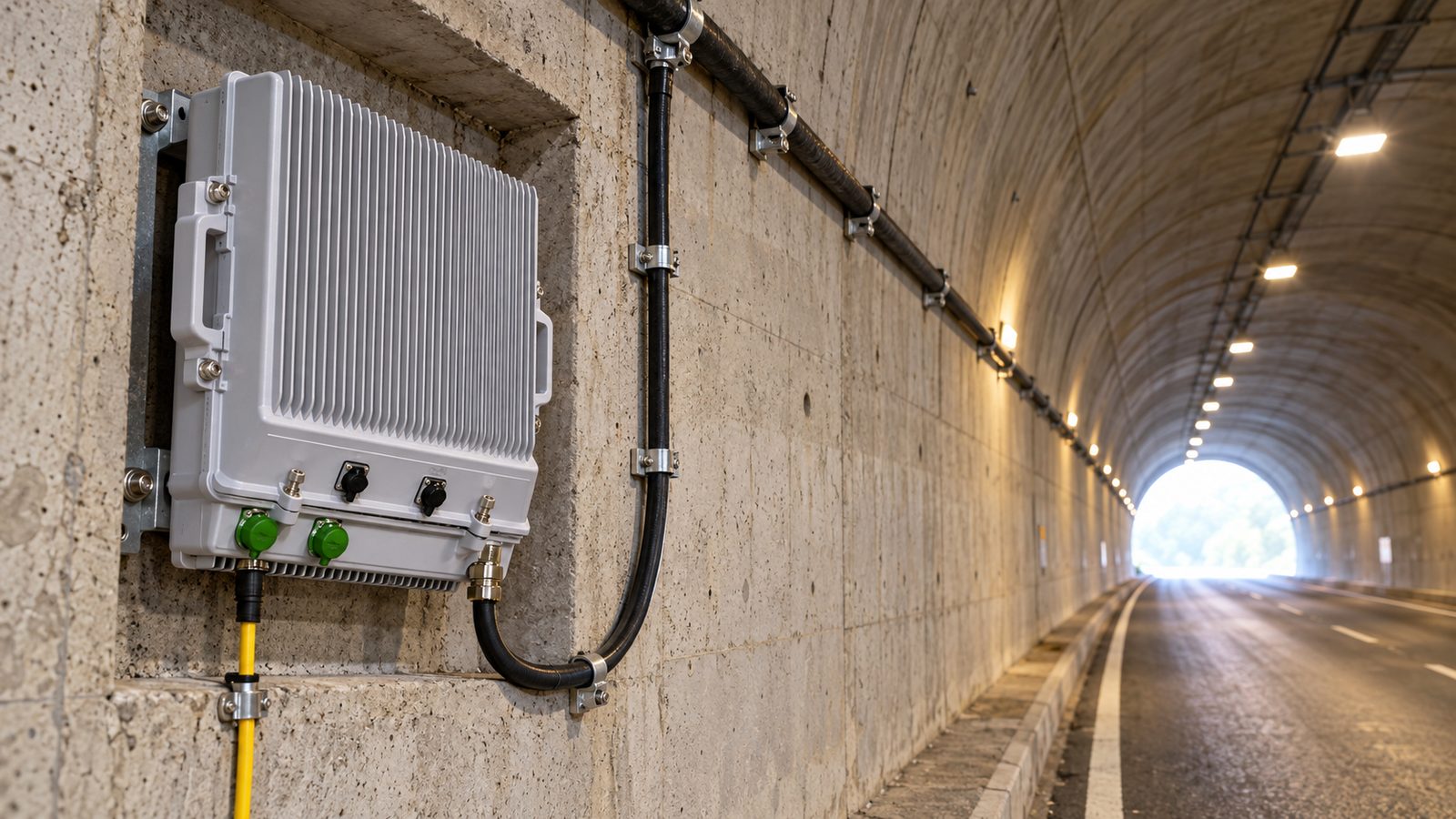
Why the signal fails here
- Radio waves do not follow a tunnel far: bends, traffic and the tunnel walls shorten the range.
- Several networks often share the system: emergency services, the tunnel operator’s radio and the mobile operators.
- In a long tunnel, coaxial cable loses too much signal, so the signal travels by fibre to remote units along the tube.
- Access is limited to closures, so per-band monitoring and remote alarms matter more than elsewhere.
- Coverage has to overlap at the portals, where outdoor and tunnel signals meet.
Which system fits
Repeater and radiating cable
A donor antenna at the portal and a repeater feeding a radiating cable. Fits shorter tunnels with a usable signal at the portal.
Fibre-fed remote units
A master unit at the portal and remote units along the tube, each feeding a section of radiating cable. Fits long tunnels and metro lines.
Combining networks
Combiners and a point of interface bring TETRA and each mobile operator onto one antenna system without disturbing each other.
Who has to agree
These rules apply in Belgium. In other countries the principle is usually the same, but ask the local operator.
Mobile operators
A repeater or DAS may only carry a mobile network with the permission of that network’s operator, and a system that carries several networks needs the permission of each operator. Only operators may activate active equipment in their bands, and BIPT only allows repeaters that operators install themselves or accept responsibility for. The Belgian regulator BIPT explains this on its website. The agreement therefore comes before anything is bought or switched on.
ASTRID, the radio network of the emergency services
For new large buildings and infrastructure, a Safety Commission under the FPS Interior decides whether indoor ASTRID coverage is required. The building owner then signs an agreement with ASTRID, the design goes to ASTRID for review, and ASTRID inspects the installation before it connects. The owner then sends ASTRID a maintenance report every year. ASTRID’s review only confirms that its network is not disturbed, not that coverage is sufficient. ASTRID describes the procedure on its website (in Dutch and French).
ASTRID only accepts repeaters and base stations it has validated. The models in our catalogue are not on the list ASTRID has published (January 2024 version), so for a project on its network we check the current list with you before anything is specified.
Plan for what comes next: the BIPT guidelines note that ASTRID is moving towards a broadband network, and that the current TETRA network stays in operation until 2030–2032. Ask ASTRID which bands your design should allow for. ASTRID also requires remote access to the installation, so that it can be switched off from a distance in case of a fault.
How a project runs
- 01
Measure
Signal per operator and band in each zone, and the outdoor signal where a donor antenna could go.
- 02
Choose the route
A solution from the operator, a repeater or a DAS: this depends on the size of the site, the signal available outside and the number of operators.
- 03
Design
Antenna positions, cable routes, a link budget (the calculation of signal levels from source to antenna) and the equipment list.
- 04
Request the agreements
Technical information for each operator and, where needed, for ASTRID. Nothing is ordered or switched on until each of them has agreed.
- 05
Supply and install
Equipment with a test record per unit. Your installer does the work, or a contractor agreed with you for the project.
- 06
Commission and maintain
Measuring the signal on foot through the site (walk test) against the design, and handover documents. Regular maintenance follows under its own contract, with your installer or a maintenance firm.
If you own or manage the site
- Send us the plans and tell us where the signal fails. You do not need to know the technology.
- We measure, propose a route and tell you which agreements it needs, scoped and quoted per project.
- We prepare the technical information each operator asks for: bands, gain, output power and location.
- Installation is done by your own installer, or by a contractor agreed with you for the project.
- Ask your main operator as well: operators also offer indoor solutions of their own.
If you are the integrator
- Product selection for the site, from the catalogue or to a build specification.
- Support on link budgets, DAS layouts, measurements and commissioning: see engineering support.
- A test record with every unit, and one contracting party in Brussels.
- Your own product line if you need one: see OEM / ODM.
What to send us
- Length, number of tubes and cross-section of the tunnel
- The networks to carry, with bands and channels
- How the signal arrives: a donor antenna or a base station
- Fibre and power available along the tunnel, and any backup-power requirement
- How alarms must be reported, and to whom
Common questions
Radiating cable or antennas?
Radiating cable gives an even signal along a tube, also behind trucks and trains. Antennas can do for short sections or wide cross-sections. The link budget decides, section by section.
Can TETRA and mobile networks share one system?
Yes, with combiners and a design that allows for the chosen bands from the start, although the guidelines advise against combining 3400–3800 MHz with ASTRID. The BIPT guidelines note that a system built for ASTRID does not carry mobile operators by itself: their requirements have to be in the design as well.
Can you supply for the ASTRID network?
ASTRID only accepts equipment it has validated, and our catalogue models are not on the list it has published (January 2024 version). A model that is not on the current list cannot be used on the ASTRID network, so we check that list with you first.
What about tunnels outside Belgium?
The system design is the same. The networks, bands and the party that has to agree differ per country: tell us the country and the network operator.
Other sites
Underground car parks
Parking and charging apps, payment terminals and emergency calls need a signal below ground.
Warehouses and industrial sites
Steel, racking and long distances, with handhelds and machines that rely on the network.
Multi-operator DAS
How the Belgian process works: notification, operators’ answers, design, activation and maintenance.
Tell us about the site
A few answers are enough for a first product selection.
Planning a product line under your own brand? Use the OEM / ODM form.
- A product selection for the site
- A first link budget where the site needs one
- The list of what we still need from you, such as floor plans or donor measurements
You can attach floor plans here, or send them by email later.